
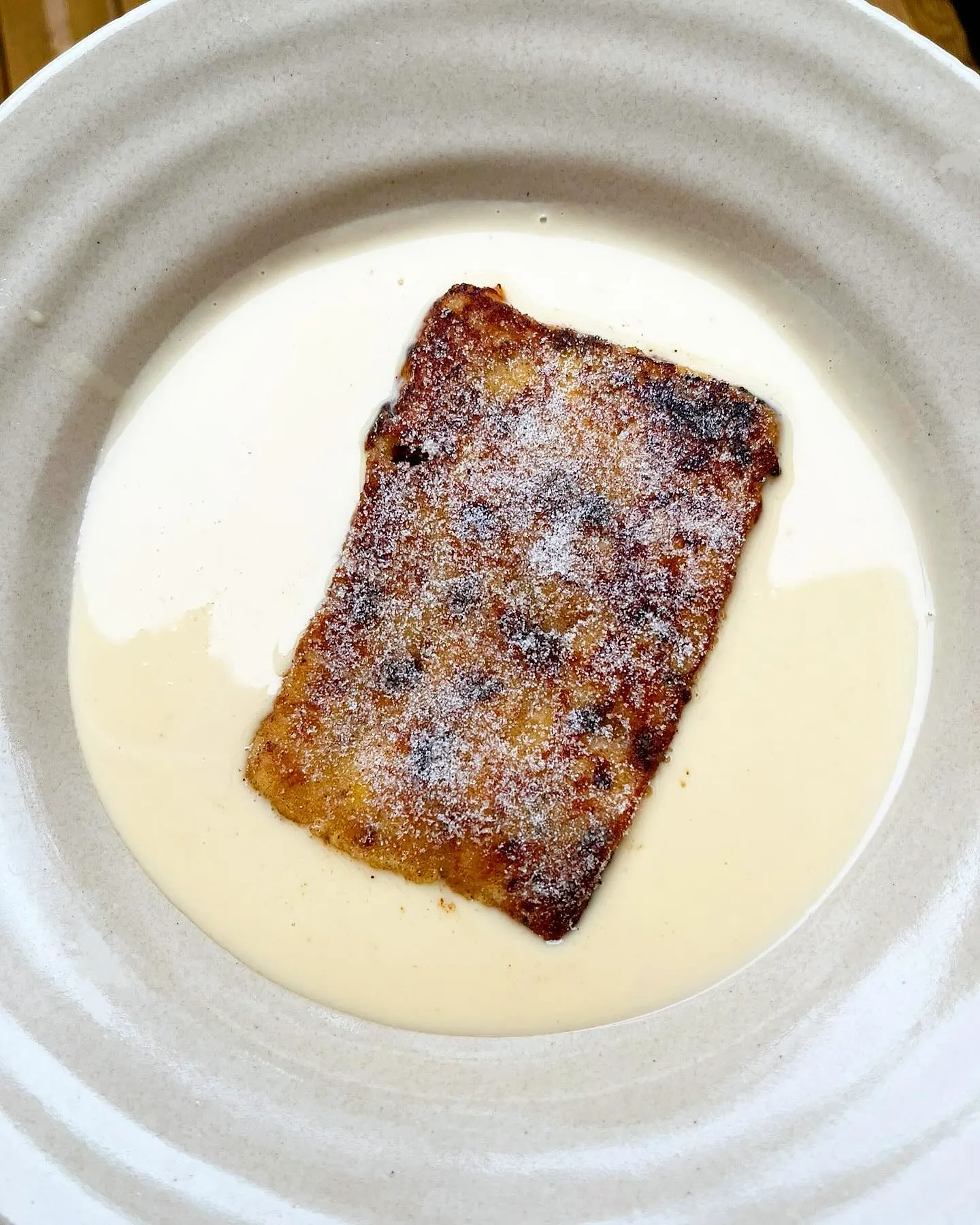
Leftover panettone going dry and pointless on your counter is the exact problem this recipe solves.
I learned this the hard way on a Saturday morning last December. My sister had gifted us a towering panettone, and by the third day it sat there, half-eaten and starting to feel like a decorative object.
My kids were circling the kitchen asking for “something special” for breakfast, and I had about twenty minutes of patience left. So I sliced it thick, dunked it in the egg batter I usually reserve for regular French toast, and fried it up.
It was so good that I made it again the next morning, and then again on Christmas Day, only that time with a ginger-and-blonde-chocolate crème anglaise poured around each slice.
What makes this different from ordinary French toast is the panettone itself. It is rich, buttery, and studded with candied fruit, so it behaves like a cross between brioche and cake.
The slices hold their shape, the edges get impossibly crisp, and the whole thing feels festive without requiring any actual effort. This is the kind of dish that makes people think you spent all morning in the kitchen.
You will not have.
Can You Really Make French Toast With Panettone?
Absolutely, and honestly panettone is one of the best breads you can use for it. Traditional French toast calls for something enriched and slightly stale — brioche, challah, thick-cut Texas toast.
Panettone fits right into that family. It is an Italian holiday bread made with a very enriched dough, so it is naturally custardy and tender inside.
The only thing to watch is how quickly it drinks up the egg mixture. Panettone is more delicate than brioche, so you want to give it a short soak — about a minute — rather than leaving it sitting in the batter.
If your panettone is fresh from the box, you can leave the slices out on the counter for an hour or two first to dry them out slightly. Day-old bread is genuinely better here for the same reason it is better in my creamy parmesan polenta with peas and eggs — dried starch soaks up custard without turning to mush.
And yes, the candied fruit in the bread is welcome. It caramelizes slightly in the pan and adds little bursts of sweetness.
If you are a fruit-in-bread skeptic and want to pick around the orange peel, no judgment. I do it sometimes too.
What Is Blonde Chocolate and Can You Substitute It?
Blonde chocolate, sometimes sold as caramelized white chocolate or Dulcey-style chocolate, is white chocolate that has been slowly roasted until it turns a warm golden color and develops toffee and caramel notes. It is not as sweet as regular white chocolate, and it has a lovely toasted depth that pairs beautifully with ginger.
If you cannot find it, you have a couple of decent options. Regular white chocolate works fine, though the sauce will be sweeter and a bit flatter in flavor.
A better swap is to use half white chocolate and add an extra half teaspoon of ground ginger plus a tiny splash of vanilla. You can also caramelize white chocolate yourself at home by spreading it on a sheet pan and baking it at 250°F, stirring every ten minutes, until it turns golden and smells like butterscotch.
It takes about 45 minutes, so it is a project rather than a shortcut, but it is a fun one.
How to Make Crème Anglaise Without Scrambling the Eggs
This is the part that intimidates people, and I get it. You have a bowl of raw egg yolks, a pan of hot milk, and one wrong move gives you sweet scrambled eggs instead of silky sauce.
The trick is tempering, and it takes about ninety seconds of focused stirring.
Whisk the yolks with sugar and ginger first so they are loosened and combined. Then pour the hot milk mixture over them in three separate additions, stirring the whole time.
Adding it gradually warms the eggs slowly so they do not shock and curdle. Once everything is combined, you pour it all back into the pan and cook over low heat, stirring constantly, until it thickens enough to coat the back of a spoon.
If you drag your finger across the coated spoon and the line holds, you are done. That happens somewhere around 170°F to 175°F.
Then you strain it over the chopped blonde chocolate. Straining is not optional in my book — it catches any bits of cooked egg and makes the sauce impossibly smooth.
Let it sit for a minute so the chocolate melts, then stir gently until glossy. A pinch of flaky salt at the end keeps the sweetness in check.
If you want to keep things warm while you cook the French toast, set the bowl over a pan of barely simmering water. A crème anglaise that gets too hot or too cold either splits or turns into pudding, and neither is what you want for pouring.

Why the Spiced Sugar Coating Matters
Frying the panettone gets you crisp edges. Rolling it in cinnamon and ginger sugar while it is still hot from the pan gets you that crackly, fragrant shell that makes this recipe feel like a real occasion.
The sugar sticks because the surface is still slightly buttery and warm, so you want to do the dredging right away, not after the toast has cooled.
The coating is also where the ginger shows up in a big way. Between the stem ginger syrup and ground ginger in the crème anglaise and the ground ginger in the sugar, there is a warm, almost spicy backbone running through the whole dish.
It keeps the sweetness from becoming one-note, and it makes the whole thing smell like the holidays in the best possible way.
Finish each bowl with a small pinch of flaky salt. It sounds fussy.
It is not. Salt on top of a sweet, custardy breakfast is one of those tiny details that separates a good dish from one people talk about afterward.
Make-Ahead and Serving Tips for Holiday Brunch
This recipe serves four and takes about forty minutes start to finish, which makes it entirely realistic for a holiday morning even when there are other things happening in the kitchen. If you want to get ahead, whisk the egg and milk mixture the night before and keep it covered in the fridge.
The spiced sugar can be mixed days in advance and left in a jar on the counter.
The crème anglaise can also be made a day ahead. Reheat it very gently over low heat, whisking constantly, or give it a few short bursts in the microwave, stirring between each one.
It should be pourable, not thick.
For serving, I ladle a pool of the warm sauce into each bowl and rest the French toast on top or beside it. If you are building a larger holiday spread, this sits alongside other brunch favorites without much fuss, and it pairs surprisingly well with something savory like an herby garlic yogurt egg dish if you want to balance the sweetness.
For a dinner party ending, a rich chocolate skillet cookie never gets a second glance when this French toast is on the table at breakfast.
Leftovers, if you somehow have any, reheat beautifully in a 350°F oven for about eight minutes. The sugar coating softens but the flavor holds.
Keep the sauce in a jar in the fridge and gently rewarm it before serving.
One Last Note on Panettone
Use whatever panettone you can find — the grocery store kind works perfectly well here, and so does the fancy one from an Italian market. You do not need to be precious about it.
The whole point of this recipe is that it turns a bread that is easy to overlook into something worth gathering around the table for.
And if you are already thinking about the rest of the holiday menu, a slow-roasted beef tenderloin with horseradish butter later in the day is a strong companion to a morning this indulgent. Now go soak some panettone.
Sugared Panettone French Toast with Ginger & Blonde Chocolate Creme Anglaise
Description
Ingredients
For the Creme Anglaise
- ¾ cup whole milk
- ¾ cup double cream
- ⅓ cup caster sugar
- 2 tablespoons stem ginger syrup
- 1 teaspoon ground ginger
- 3 large egg yolks about 60g total
- 2½ ounces blonde chocolate roughly chopped
- pinch flaky salt
For the Panettone French Toast
- 4 thick slices panettone
- 2 large eggs
- ¾ cup whole milk
- 1 tablespoon butter knob
- 2 tablespoons caster sugar for the egg mixture
- ⅓ cup caster sugar for the coating
- 1 teaspoon cinnamon
- 1 teaspoon ground ginger
- pinch flaky salt
Instructions
- Start by making the crème anglaise. Place the milk, cream, half the sugar, and the stem ginger syrup in a saucepan and gently heat to scalding point.
- Meanwhile, place the egg yolks, the remaining sugar, and the ground ginger in a bowl and whisk together.
- Pour the hot milk mixture over the egg yolks in three batches, stirring constantly. Return the mixture to the saucepan and, over low-medium heat, stir until thick enough to coat the back of a spoon.
- Place the chopped blonde chocolate in a heatproof bowl and strain the crème over it. Let it sit for a minute, then gently stir until smooth. Add a pinch of salt, then set aside and keep warm.
- For the panettone French toast, whisk together the eggs, milk, and 2 tablespoons of caster sugar. Pour this mixture into a wide shallow bowl and soak the panettone slices for around a minute. They should be well coated but not so soggy that they fall apart.
- In a separate bowl, combine the ⅓ cup of caster sugar with the cinnamon and ground ginger. Set aside.
- Heat the butter in a frying pan and, once foaming, add the soaked panettone slices. Cook for a few minutes on each side until the outside is crisp and golden. Immediately dredge the slices in the spiced sugar.
- To serve, ladle the crème anglaise into four bowls and add a slice of panettone. Finish with a pinch of flaky salt.
Notes
- Use day-old panettone if possible — slightly dried bread soaks up the custard without falling apart.
- Keep the crème anglaise warm over a very low heat or in a bain-marie so it stays pourable.
- Dredge the French toast in the spiced sugar right after it comes off the heat so the coating sticks.
Comments & feedback
A clean, soft editorial comment area that matches the rest of the site’s premium green-and-neutral look.